
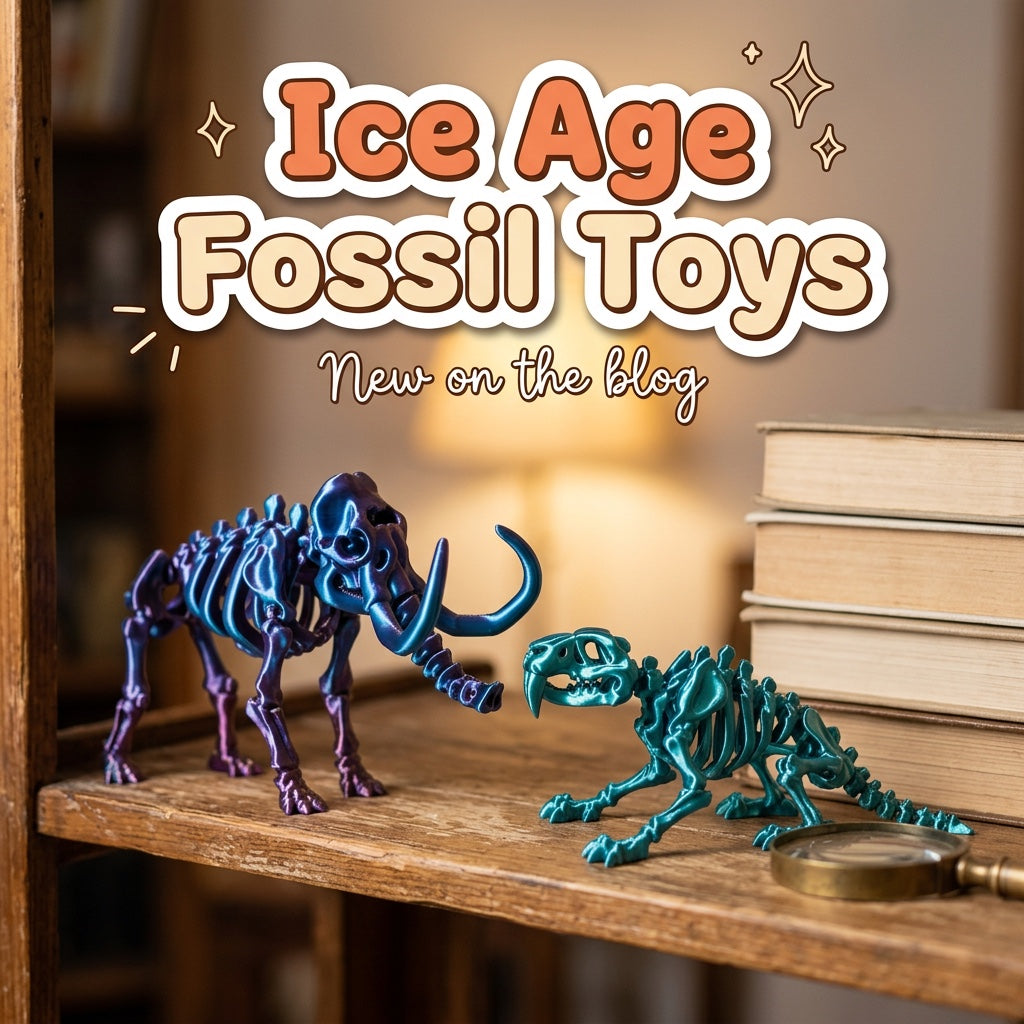
The Skeleton Mammoth is our Ice Age fossil flexi: a woolly mammoth stripped to its bones and printed in place as one articulated piece. The trunk swings, the spine bends and the tusks point wherever you aim them. It comes in Baby for $5, Regular for $12 and XL for $35, like every skeleton we print.
This guide is for fossil fans, dinosaur kids who have moved on to museum skeletons, and anyone building a shelf of fossil toys. We cover the Skeleton Mammoth and its Ice Age neighbor, the Skeleton Saber Toothed Tigers, and then five more fossil flexis that our earlier dinosaur comparison only named in passing: the Brontosaurus, Parasaurolophus, Ankylosaurus, Triceratops and Pteranodon. The T-Rex, Raptor and Spinosaurus have their own comparison post, so we leave them out here.
For an Ice Age pair, order the Skeleton Mammoth and the Saber Toothed Tigers in the same size, then add one dinosaur from each era if you want the shelf to tell the whole story.
The Skeleton Mammoth: Trunk, Tusks and an Ice Age Spine
The Skeleton Mammoth is one of only two mammals in our fossil line, alongside the Saber Toothed Tigers. Mammoths were elephants, and they lived during the last Ice Age, tens of millions of years after the last dinosaurs. It sits in our dinosaur collection because that is where fossil fans look for it.
The trunk is the part people pick it up for. It is a chain of short segments, so it curls up toward the skull, hangs straight down, or reaches forward as if the mammoth is feeling for something on the ground.
The tusks are two long curves that sweep out and up from the skull. They are fixed to the head, so when you turn the head, the tusks lead.
The spine and ribcage run back from a tall, rounded skull to a short tail. The legs are thick and bony, built to stand rather than run. Set the Skeleton Mammoth down in a walking pose and it holds it.
The product photo shows it in a shiny blue and purple blend that shifts along the bones. That is a good example of what the Rainbow and Dual color styles do on a long skeleton.
Skeleton Saber Toothed Tigers: The Mammoth's Ice Age Neighbor
Saber-toothed cats and mammoths lived at the same time and in the same places, including Texas. That makes the Skeleton Saber Toothed Tigers the natural partner for the Skeleton Mammoth. Despite the name, they were not tigers. They were a separate branch of the cat family, best known from Smilodon.
The skull carries two long saber fangs that hang below the jaw. They are the first thing anyone notices, and they make the figure look fierce even at Baby size.
The body has an open ribcage, a spine of vertebrae, bony legs with claws and a short tail. The head lifts and lowers, and the legs settle into a prowl or a low crouch that holds.
The listing photo shows two looks side by side: a shiny gold and copper blend and a shiny teal. It was added to the catalog on October 14, along with the Brontosaurus and Parasaurolophus below.
Posing the Ice Age pair
Our favorite way to show the two together is a standoff. Put the Skeleton Mammoth with its head lowered and tusks forward, and the saber-toothed cat in a crouch facing it. In the same size, the mammoth stands taller and longer, which matches the real animals.
Two New Plant Eaters: The Skeleton Brontosaurus and Parasaurolophus
The Skeleton Brontosaurus is all neck. The vertebrae run up that long neck to a small skull, so the neck swings up as if browsing in treetops or dips down low to drink. The tail curls, and the legs settle into a stance that holds. Its photo shows a shiny teal, purple and lime mix next to a softer blue and white.
The Skeleton Parasaurolophus is the one with the swept-back crest. A long curved crest runs back from the skull, above a grinning beak, with tall spines over an open ribcage and a long bony tail. The neck tips, the legs shift into a stride, and the tail swishes from side to side. Its photo shows a pastel pink and yellow blend and a blue and white one.
Both are good for a child who already owns a T-Rex and wants the animals it lived alongside. The Parasaurolophus is also the least common dinosaur in most toy boxes, which makes it a good pick for a collector who has the famous ones already.
Armor, Horns and Plates: Ankylosaurus, Triceratops and Stegosaurus
These three are the defensive dinosaurs, and each skeleton keeps the feature that made the animal famous.
The Skeleton Ankylosaurus strips the armored dinosaur down to a museum-style mount, with bone detail along its whole length. It is low and wide, so it sits flat on a shelf and looks solid even though it is mostly open space.
The Skeleton Triceratops keeps its three horns and its frill. Because it is a skeleton, you can watch each joint move as you bend it. It pairs naturally with a Skeleton T-Rex, since the two lived at the same time.
The Skeleton Stegosaurus keeps the row of plates standing along its spine. It is the one to choose for a child who names the Stegosaurus as a favorite, which is more children than you might think.
The Skeleton Pteranodon Is the Fossil That Flies
The Skeleton Pteranodon is a flying reptile, not a dinosaur, though it lived in the same age. It has a long crested head on a jointed neck, and wings that spread wide or fold in for the shelf.
The wings make it the widest of our skeletons and give it a shape nothing else in the line has. They also hold the thinnest bones we ship, at the wing tips. That makes the Pteranodon a display piece first. For a younger child, the Skeleton Mammoth or Ankylosaurus is a sturdier choice.
Build a Fossil Toys Timeline on One Shelf
A row of fossil toys looks good on its own. Arranged by era, it also teaches something. The animals in our skeleton line fall into three groups, and the gaps between them are larger than most people expect.
The Jurassic, about 150 million years ago: the Brontosaurus and the Stegosaurus. Put them at the left end of the shelf.
The Late Cretaceous, about 85 to 66 million years ago: the Pteranodon first, then the Parasaurolophus, and then the Triceratops, Ankylosaurus and T-Rex, which all lived at the very end of the dinosaur age.
The Ice Age, which ended about 12,000 years ago: the Skeleton Mammoth and the Saber Toothed Tigers, at the right end.
Leave a big gap between the Stegosaurus and the T-Rex, and a bigger one before the mammoth. The Stegosaurus and the T-Rex are separated by more time than separates the T-Rex from us. Children usually remember that fact long after the toys are put away.
Texas makes the Ice Age end of the shelf local. Mammoth fossils have been dug up across the state, and Waco has a national monument built over a mammoth site. A Skeleton Mammoth is an easy souvenir after a museum or a dig-site trip.
What a Set of Fossil Toys Costs
Every skeleton uses the same size menu: Baby at $5, Regular at $12 and XL at $35. Baby fits a pocket or a party favor bag, Regular is the desk size, and XL is for display. Shipping is $3.99 under $35 and free Economy shipping from $35.
The Ice Age pair in Baby, $10. A Skeleton Mammoth and a Saber Toothed Tigers figure. With shipping, $13.99.
The Ice Age pair in Regular, $24. The desk size, and the one we would give as a gift. With shipping, $27.99. Add a Regular Triceratops and it reaches $36 and ships free.
The timeline shelf in Regular, $60. A Stegosaurus, a Parasaurolophus, a Triceratops, a Skeleton Mammoth and the Saber Toothed Tigers: one or two from each era. Ships free.
Every skeleton in Baby, $55. Eleven skeleton dinosaurs and Ice Age animals share this size menu, and a Baby of each makes a complete fossil herd that fits in a shoebox. Ships free.
The Ice Age pair in XL, $70. For a collector's shelf. Ships free.
For colors, the menu offers Rainbow - Will Vary, Single, Dual, Surprise Me!! and Girl Colors. If you want a museum look, choose Single and type bone white or tan in the Custom color box. Our dinosaur comparison post explains each color style in more detail.
Common Questions About the Skeleton Mammoth
Is a mammoth a dinosaur?
No. A mammoth is a mammal, a relative of today's elephants. Mammoths appeared tens of millions of years after the dinosaurs died out. We keep the Skeleton Mammoth in the dinosaur collection because it is a fossil, and that is where fossil fans look.
Does the Skeleton Mammoth have fur?
No. It is the skeleton only: skull, tusks, trunk, spine, ribs and legs. The bones are what make it look like a museum mount.
Which size is best for a child?
For a child of about six and up, Regular at $12 is big enough to handle easily and stands up well. The Baby size has small parts, so keep it away from toddlers. Skeletons have thin bones in places, so for rough play a solid flexi is the better toy.
How do I keep a fossil shelf looking good?
Dust it with a soft brush or wipe it with a soft cloth. Keep it out of direct sun and hot cars, because PLA softens above about 140°F. Never put a flexi in the dishwasher.
Start With the Skeleton Mammoth, Then Fill In the Eras
If you only buy one fossil toy from this guide, make it the Skeleton Mammoth. It is the biggest animal in the Ice Age half of the line, and the trunk gives it a movement no dinosaur has. Add the Saber Toothed Tigers and you have a matched Ice Age pair for $10 in Baby or $24 in Regular.
From there, add one dinosaur at a time and arrange the shelf by era. The whole line is in our dinosaur collection.
At Cosmic 3D Creations, every skeleton is printed to order by our family in Como, Texas, in premium PLA and the colors you choose, and checked joint by joint before it ships. If you would rather see the fossils in person, visit us at Canton Trade Days from December 3 to 6. Message us before you order to pick up at our Canton Trade Days booth.