
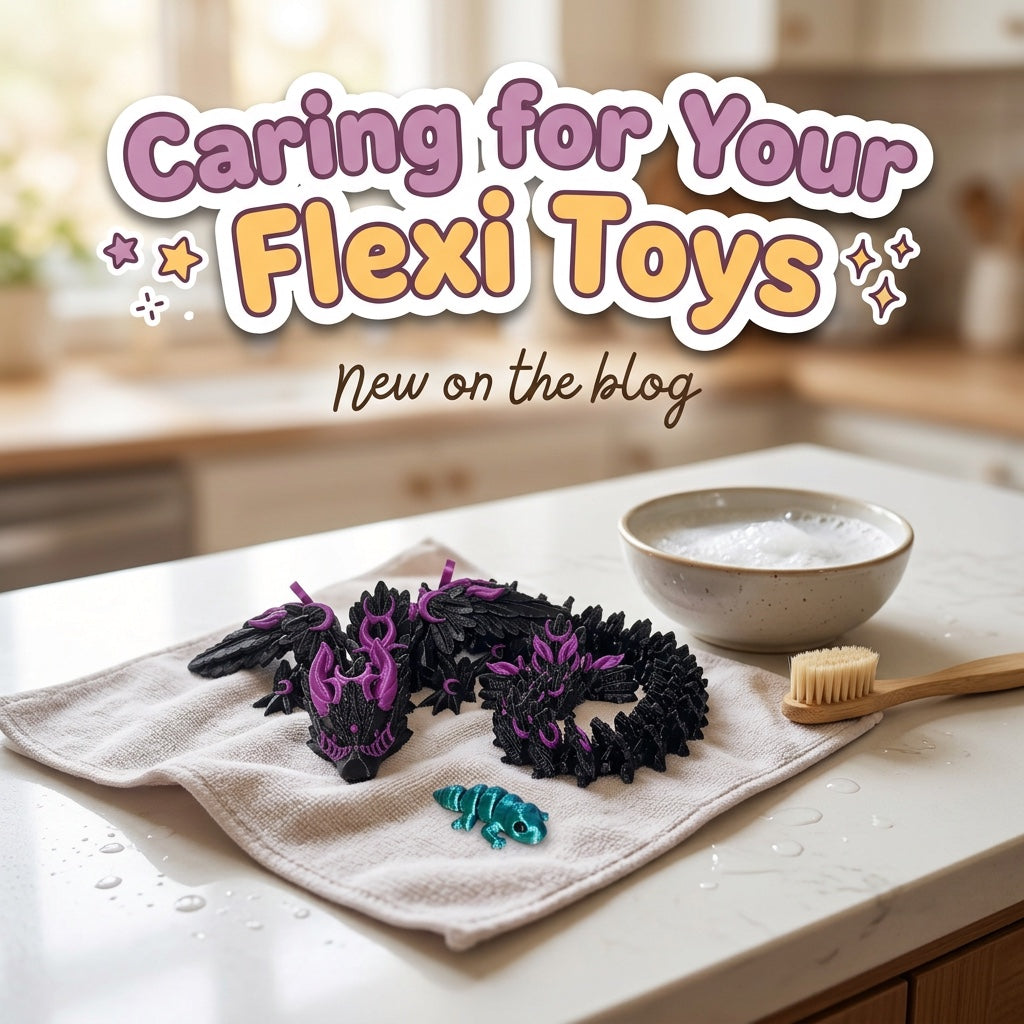
This guide is for anyone who owns an articulated 3D print and wants it to keep moving. A flexi dragon that gets fidgeted with every day should still curl and click through its joints a year on, and with a little care it will.
Flexi toys are tougher than most people expect, but they are plastic parts with dozens of tiny hinges. Below is what we tell customers at our booth: how to clean one safely, keep the joints free, store a collection, and fix the common mishaps. A five-minute check each month keeps a flexi toy moving for years.
Heat, Sunlight and Grit Are What Wear a Flexi Toy Down
Molded toys are cast from a single melt, which gives them a smooth, sealed skin. A 3D printed toy is built from hundreds of thin layers of PLA fused together. That layered structure is what makes print-in-place joints possible, since each hinge is printed with a hair-thin gap. It also leaves tiny ridges on the surface where dust and skin oils settle.
Three things age a print:
Heat is the big one. PLA starts to soften around 130 to 140 degrees Fahrenheit (55 to 60 degrees Celsius). A car dashboard in a Texas summer passes that easily, and a warped flexi toy never moves the same way again.
UV light fades pigments and makes the surface brittle. Silk and rainbow filaments are the most sensitive, because their shimmer comes from fine pigment particles near the surface.
Grit is the sneaky one. Sand, pocket lint and dried food work into the joints and act like sandpaper every time the toy flexes.
Most Flexi Toys Only Need a Quick Wipe
Brush Dust Out of the Joints
A soft, dry paintbrush or an unused makeup brush is the best tool a print collection can have. Brush along the joints and between the scales to lift dust before it packs in. For stubborn lint in a joint, use a wooden toothpick. Metal picks scratch the layer lines.
Wash a Dirty Toy in Lukewarm Soapy Water
When a toy is actually dirty, wash it by hand.
Use lukewarm water only. Warm to the touch is fine. Steaming is not.
Add a drop of mild dish soap. Skip bleach, citrus oils and degreasers, which can cloud the surface.
Work the joints under the water. Flexing the toy while it is submerged flushes grit out of the hinges better than scrubbing.
Rinse, shake and air dry. Water hides inside the segments. Shake the toy out over a towel and let it dry completely before it goes back in a bag or box.
Never put a 3D print in the dishwasher. The heated dry cycle alone is enough to soften PLA, and a warped dragon cannot be fixed.
A Stiff Joint Usually Needs Cleaning, Not Oil
A well-printed flexi toy moves with a soft, even resistance. A joint that feels gritty or squeaks usually needs cleaning rather than lubricant.
Flex It Every So Often
A print that sits untouched for months can develop a slight stickiness where the segments rest against each other. A few full flexes now and then keeps everything free.
Lubricate Only a Large Piece That Binds
Most flexi toys should never be lubricated. Oil attracts dust, stains lighter colors and makes a toy unpleasant to handle. The exception is a large, heavy piece, such as a 24 inch crystal dragon with a joint that binds after cleaning. In that case:
Use a dry PTFE lubricant made for plastics, or a tiny amount of pure silicone lubricant. Apply it with a toothpick to the inside of the joint, not the outer surface.
Avoid petroleum products. WD-40, mineral oil and household oils soften some plastics and leave a residue that never fully dries.
Cold Makes PLA Stiff Until It Warms Up
A flexi toy left in a cold car or an unheated room feels tight until it reaches room temperature. Let it warm in your hands rather than near a heater.
Where a Flexi Toy Lives Matters More Than How Often It Is Cleaned
Shelves and Desks Away From Windows Are Ideal
Interior shelves, desks away from windows, bookcases and enclosed display cabinets all work. Indirect light shows off silk and rainbow finishes without fading them.
Places to Avoid
Sunny windowsills. Direct afternoon sun combines heat and UV, the two things PLA dislikes most. A rainbow filament can fade noticeably in one summer on a south-facing sill.
Cars. Dashboard temperatures routinely pass 150 degrees Fahrenheit. A flexi keychain on your keyring is fine because it travels with you, but a toy left on a seat in July will warp.
Bathrooms. Repeated steam is a slow version of the dishwasher problem.
Heat vents, radiators and the top of a gaming PC. Warm air rising from electronics is enough to soften thin tail segments over time.
Store a Collection Flat, Separated and Dry
Lay flexi toys flat or loosely coiled. PLA has a small amount of memory, and a tail stored in a tight circle for months can keep a permanent curve.
Keep them separated. Tackle boxes, craft organizers or zip bags stop scales rubbing and prevent color transfer between dark and light prints.
Add a silica packet in a humid space such as a garage. PLA absorbs a little moisture over time, which makes it slightly more brittle.
Flex Within the Joint's Range and Hold Big Pieces by the Body
Flexi toys are made to be handled constantly. A few habits still extend their life.
Flex within the natural range. Articulated joints rotate. They do not hinge backward. Forcing a joint past its stop is the most common cause of a broken segment.
Hold larger dragons by the body, not the tail. A 16 inch dragon has real weight, and the last few tail segments are the thinnest parts of the print.
Pick up winged designs by the body. Dragon and pteranodon wings flex a little but are not meant to bend sharply.
Keychains take the hardest life. A flexi keychain gets dropped, sat on and dragged across counters daily. For everyday carry, choose a smaller design with fewer thin details, and check the keyring hole for wear now and then.
Most Damage Can Be Repaired at Home
A Popped Joint Presses Back Together
Some designs use snap-together joints that can separate under stress. Line the two halves up and press firmly and evenly. If it will not seat, warm the joint with a hair dryer on low for a few seconds, then press again. Do not use a lighter or hot water.
Super Glue Bonds a Broken Segment
Cyanoacrylate glue, the standard super glue, bonds PLA well. Apply a very small amount to one side with a toothpick tip, hold for 30 seconds, and let it cure for an hour before flexing. For a joint that must keep moving, glue only the broken part and keep adhesive out of the hinge gap.
Shiny Spots Are Cosmetic
Heavily handled prints develop polished spots where fingers rub the layer lines smooth. It is cosmetic and often looks better with age. To even it out, rub the whole surface gently with a dry microfiber cloth.
Warping Cannot Be Undone
Heat warping is the one problem that usually cannot be reversed, because the layers have physically shifted. A mildly bowed tail can sometimes be eased back with careful warming, but a fused joint will not free up. Prevention is the only real fix, which is why storage matters.
Specialty Filaments Age a Little Differently
Silk PLA has the most delicate surface. It scratches more easily than matte PLA and shows fingerprints. A microfiber wipe restores the shine.
Rainbow and multicolor filaments are standard PLA with layered pigments. Care is the same, but keep them out of direct sun to preserve the color transitions.
Glow-in-the-dark filament contains mineral particles that need light to recharge. A glow toy that has gone dim needs an hour under a lamp. It is slightly more abrasive to print but no different to care for.
Matte PLA hides layer lines and fingerprints best and is the most forgiving choice for a toy that lives in a backpack or pocket.
Kids' Toys Need a Wash and a Regular Check
Kids are harder on toys than collectors. Wash the toy before first play and after any illness, using the lukewarm soap method above. Check small designs now and then for cracked segments, and retire any toy with a piece loose enough to come off. Choose Regular or Large for younger children, since bigger segments are sturdier and easier to clean. Sizes are listed on every product page in our full catalog.
A Five-Minute Monthly Routine
At the start of each month, brush the dust off displayed pieces. Flex every joint on each toy through its full range. Check windowsills and desks for anything that has drifted into direct sun. Wipe silk finishes with a microfiber cloth.
A flexi toy kept out of the heat, brushed occasionally and flexed now and then will outlast most things on your shelf. The best-kept collections are usually the ones that get played with the most.
At Cosmic 3D Creations, every flexi toy is printed to order in premium PLA and inspected joint by joint before it ships, so it arrives moving freely. If you are unsure how to care for or repair a piece you bought from us, ask us about care or repairs and we will walk you through it.